Painting Kitchen Cabinets vs Replacing: How to Tell Which You Need
KitchenGPT7 August 20265 min read
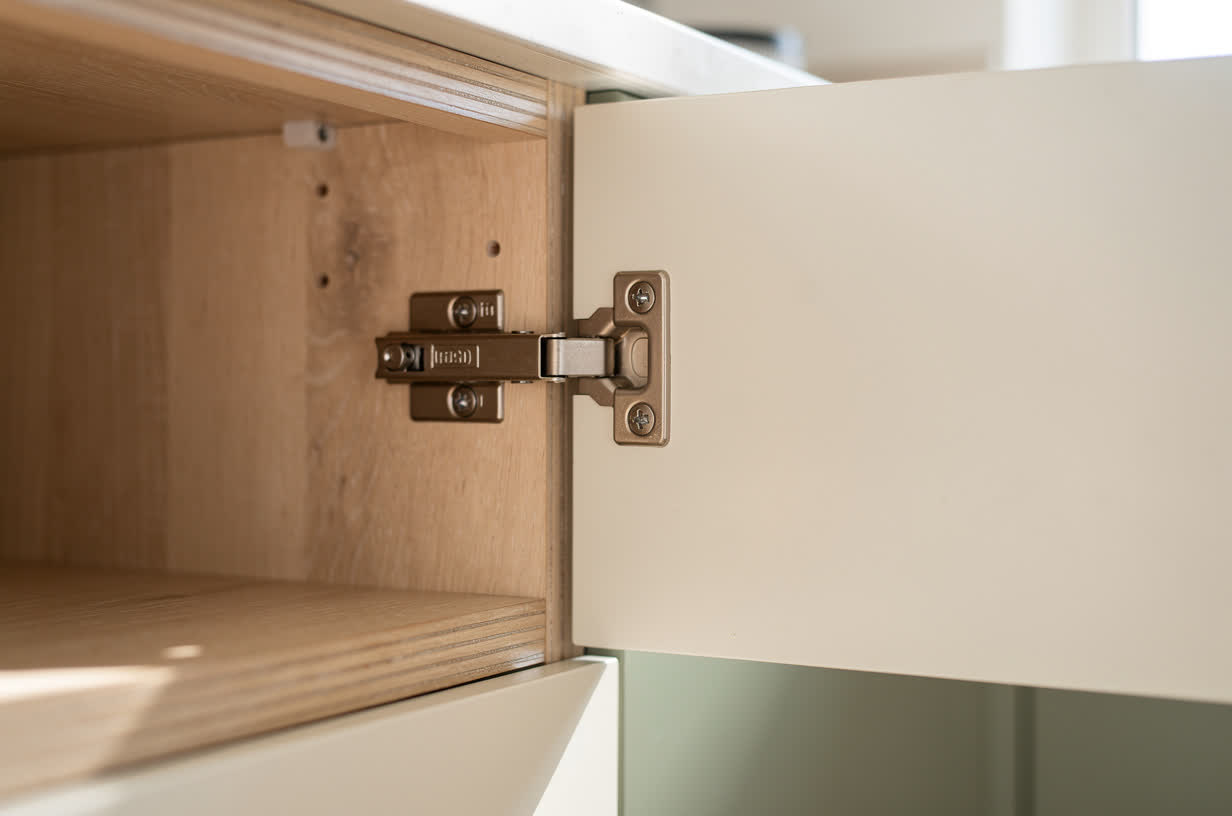
This question is usually asked as a matter of taste. It is almost always settled by something more boring: the condition of the boxes.
Cabinets are two separate things. The carcasses are the boxes screwed to your wall and standing on your floor. The fronts are the doors and drawer fronts attached to them. In most kitchens the carcasses outlive the fronts by a long way, because nothing touches them.
So the real question is not "paint or replace". It is "are the boxes worth keeping", and that has a checkable answer.
Check the boxes first
Take ten minutes and look properly. Empty one base cabinet near the sink and one away from it.
Keep the boxes if:
- The cabinets are square and the doors still line up when closed.
- There is no swelling at the bottom of the base cabinets, especially next to the dishwasher and under the sink.
- Shelves are flat rather than bowed.
- Hinges and runners still work, or are a standard type you can buy.
- The layout works for how you cook.
Replace them if:
- Any carcass is soft, swollen or crumbling at a corner. That is water damage and it does not stop.
- The cabinets are out of square enough that doors will not sit level.
- The layout is wrong. No amount of paint fixes a badly placed sink.
- The boxes are a non-standard size, so you can never buy replacement doors or hinges.
Swelling at the base of a cabinet is the one that decides it most often. It is usually a slow leak, and painting the doors of a kitchen with a wet carcass is putting a new coat on a problem.
What painting can and cannot fix
Painting fixes: color, dated wood tone, tired finish, and mismatched doors that have been added over the years.
Painting does not fix: the door profile, the layout, damaged or swollen doors, wrong-sized cabinets, or a kitchen that simply has too little storage. A raised-panel oak door painted gray is a raised-panel door in gray. If it is the shape of the doors you dislike, paint will not solve it and you will still dislike them afterwards.
That last point is where most repaint regret comes from. People dislike the style, diagnose it as the color, repaint, and find the kitchen still looks the way it did.
The option most people forget
There is a third answer between the two, and it is often the right one: keep the carcasses, replace the fronts.
New doors and drawer fronts on sound boxes gives you a different door style, a different color and new hinges, without touching the cabinets, the plumbing, the electrical or the floor. It costs more than paint and considerably less than a new kitchen, and the disruption is a day or two rather than weeks.
Choose this if the boxes are fine but you want a shape of door you cannot get by painting the ones you have.
What each option really costs you
We are not going to give you numbers here, because we could not find a source for typical repaint or refacing costs that we would be willing to publish. Quotes vary enormously by region and by how much preparation the doors need. Get three, on the same specification.
What we can say with a source is the scale of the alternative. The median spend on a major kitchen remodel is $55,000, and $75,000 for larger kitchens.1 Painting is a small fraction of that, and refacing sits between the two.
The more useful comparison is not money anyway. It is:
| Paint | New fronts | New kitchen | |
|---|---|---|---|
| Changes the color | Yes | Yes | Yes |
| Changes the door style | No | Yes | Yes |
| Changes the layout | No | No | Yes |
| Fixes damaged carcasses | No | No | Yes |
| Kitchen out of action | Days | A day or two | Weeks |
| Reversible if you dislike it | Yes, repaint | Not really | No |
That bottom row is the one worth thinking about. Paint is the only option on this list you can undo cheaply.
If you are painting, the color is the whole decision
Once you have established the boxes are sound, everything rests on getting the color right, because that is the only thing you are changing.
This is also where it goes wrong. A color chosen from a small card behaves differently across thirty doors, in your light, next to a countertop you are keeping. That is the most repeated regret in kitchen forums, and it is not carelessness: a sample genuinely cannot show you the effect of scale and light.
It matters more here than in a full remodel, because in a repaint the color is the entire project. If it is wrong, you have not got a kitchen you partly like. You have got the same kitchen, in a color you do not want, and a weekend to do again.
Two things worth doing before you buy paint:
- Paint a sample board, not the wall. Card, two coats, moved around the room and looked at morning, afternoon and evening.
- Put the color on your own doors on screen. Our cabinet color visualizer takes a photo of your kitchen and a photo of the color and shows you the two together, with your countertop, handles and floor unchanged. It is the quickest way to cut a shortlist of six down to one.
If it is the door shape rather than the color you want to change, the honest answer is that you want new fronts, and no visualizer will talk you out of that.
For where a repaint sits inside a bigger budget, see what a kitchen remodel actually costs. If you are still choosing a color, the best cabinet colors and who each suits covers that in more detail.
Sources
- Median major kitchen remodel $55,000, rising to $75,000 for larger kitchens. 2026 U.S. Houzz Kitchen Trends Study, n=1,780 U.S. homeowners. Read the study
The guidance on assessing carcasses, and the comparison table, is practical trade knowledge rather than survey data.
See it on your own kitchen before you commit
Upload one photo. Change the cabinets, the floor or the tile, and get your own room back with everything else exactly where it was.
Try it on my kitchen30 days money back. Cancel in one click. Failed generations never cost credits.