ChatGPT Kitchen Design: What It Does Well, and Where It Breaks
KitchenGPT7 August 20267 min read
Short answer: ChatGPT is genuinely useful for planning a kitchen, and unreliable for picturing yours.
Those are two different jobs, and the difference is not about prompt skill. It is about what the tool is built to do. This article covers both, honestly, including the parts where ChatGPT is better than people give it credit for.
One thing up front, since we make a competing product: we have not benchmarked ChatGPT ourselves. Everything below about its limits comes from OpenAI's own documentation, quoted and linked at the bottom. We would rather point at their words than run a test we designed to win.
What ChatGPT is genuinely good at
This part gets skipped in most comparisons, usually by people selling something. It should not be.
A kitchen remodel is mostly a long sequence of decisions and admin, and a language model like ChatGPT is well suited to that. Things it does well:
Explaining what you are being sold. Paste in a quote and ask what each line means. Ask the difference between a carcass and a door front, or what "MDF with a sprayed finish" implies for durability. This is the fastest way to stop feeling out of your depth in a showroom.
Working through a budget. Give it your total and your must-haves and ask it to allocate. Then ask it to tell you which items people most often regret cutting. It will not know your local prices, but it is good at structure.
Building a question list. "What should I ask three different contractors so I can compare their quotes fairly?" is a genuinely great prompt. So is asking what a quote is likely to be leaving out.
Sequencing the work. Asking what order a kitchen remodel happens in, and what has to be decided before what, is useful. Tile has to be chosen before the tile setter is booked. Appliances have to be chosen before the cabinets are ordered, because the openings depend on them.
Writing the brief. If you and your partner disagree, asking ChatGPT to turn a messy conversation into a one-page brief is a good use of it.
Talking through style ideas in words. It can describe what Japandi means, what tends to go with a mid-tone oak floor, and which cabinet colors behave badly in a north-facing room. As a conversation, this is fine.
None of that requires it to know what your kitchen looks like. That is why it works.
Where it breaks: a picture of your actual kitchen
Upload a photo of your kitchen, ask for it in a different style, and you will get back a beautiful kitchen. The question is whether it is yours.
This is not a rumour. It is in OpenAI's own documentation.
On editing part of an image while leaving the rest alone:
"Masking with GPT Image is entirely prompt-based. The model uses the mask as guidance, but may not follow its exact shape with complete precision."
And on structure, in their list of known limitations:
"Composition Control: Despite improved instruction following, the model may have difficulty placing elements precisely in structured or layout-sensitive compositions."
A kitchen is about as layout-sensitive as a room gets. Every cabinet meets its neighbor. The cooktop sits in a specific run. The window is where the window is, and the whole point of the exercise is to judge a change against the things that are staying.
So the failure is rarely dramatic. You do not usually get a spaceship. You get a kitchen that is nearly yours, with a window that has quietly moved, a range that has become an integrated cooktop, or a wall that is now three feet further away. It looks great. You cannot make a $55,000 decision on it.1
The same photo, two instructions
Here is the mechanism, without involving anyone else's product.
We took one photograph of a tired 1990s kitchen and ran it through the same image model twice. The only thing that changed was the instruction.
The first asked for what most people would ask for: "Redesign this kitchen in a modern style. Make it look beautiful."
The second asked for the same modern style, but added an explicit layout lock and architecture lock: keep every appliance in its exact position and footprint, preserve the walls, windows, window views, doors, ceiling, floor plan, camera angle and lighting direction.
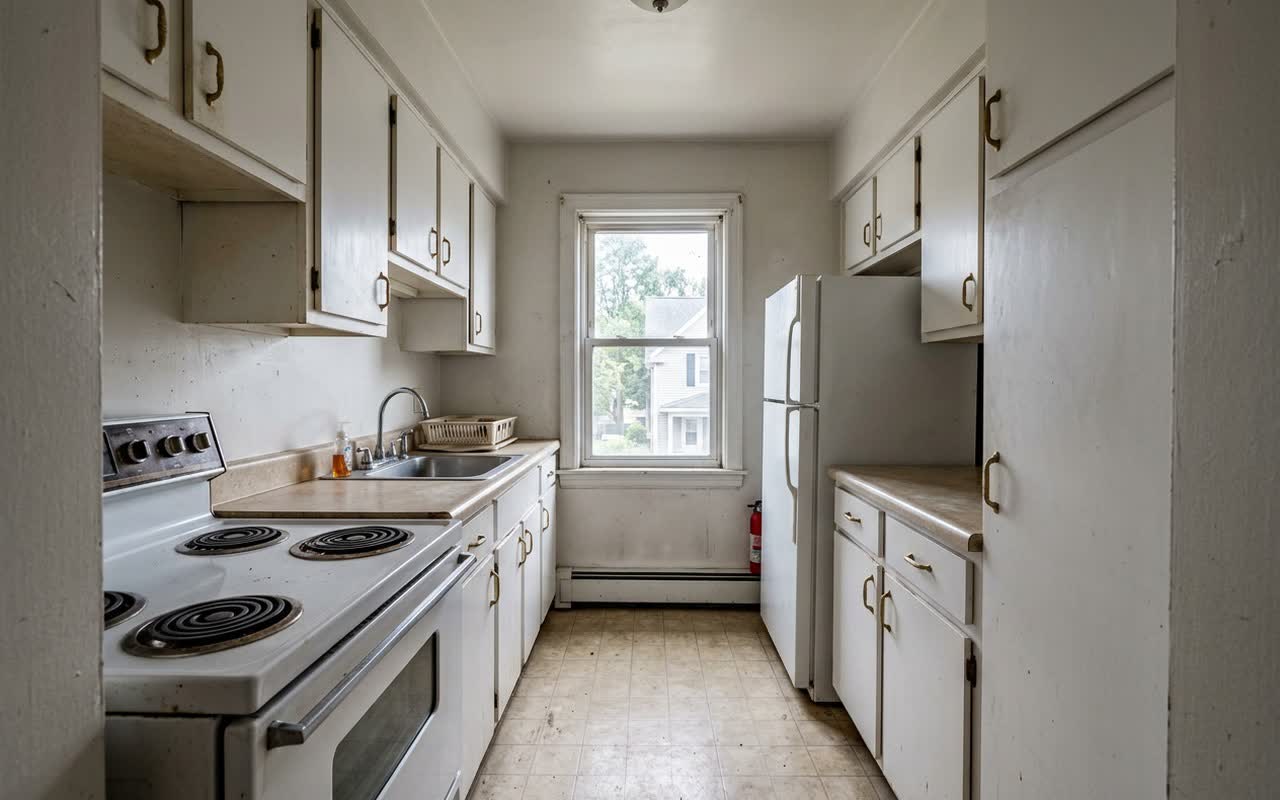
The photograph. A narrow galley kitchen: freestanding range on the left, sink under the window, fridge in the alcove on the right, radiator under the window.
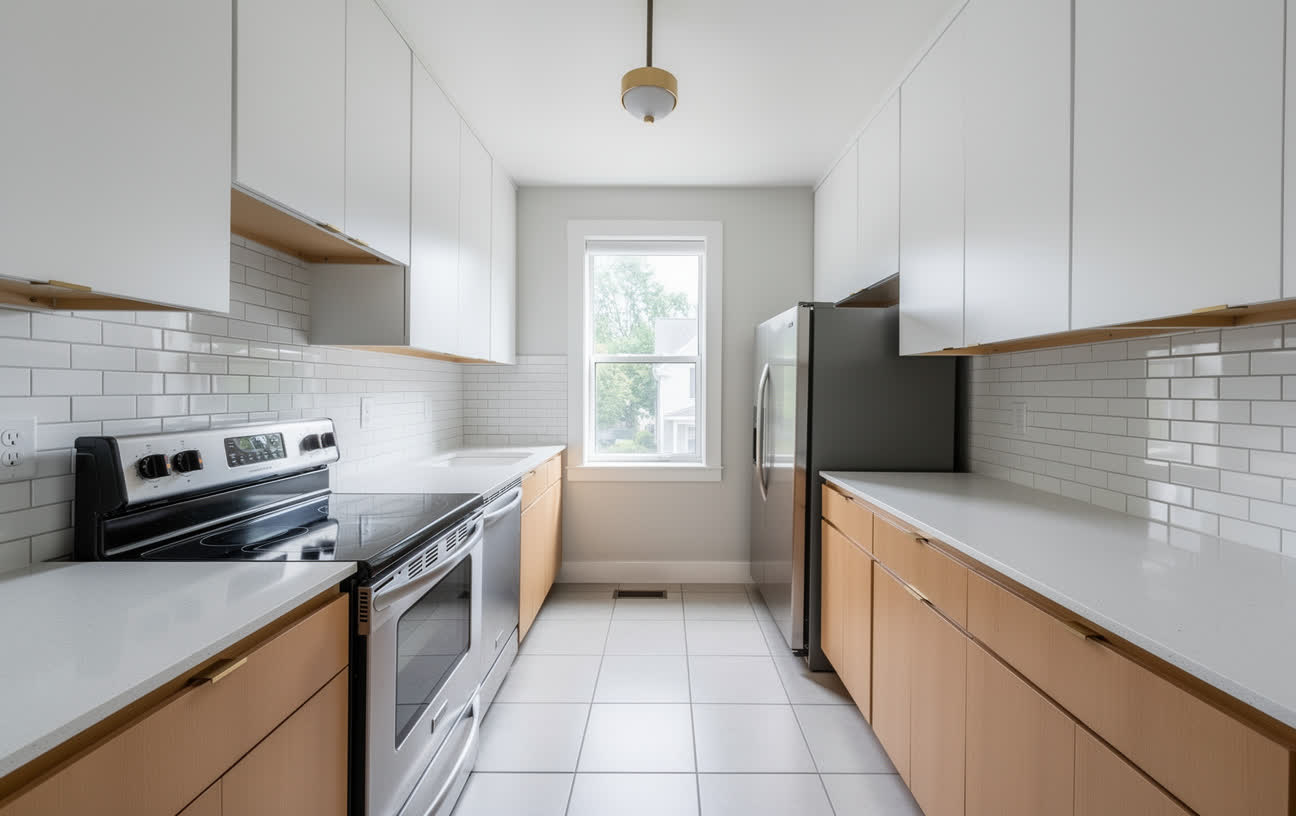
The loose instruction. A beautiful kitchen, and a different window, a different range, and no sink at all.
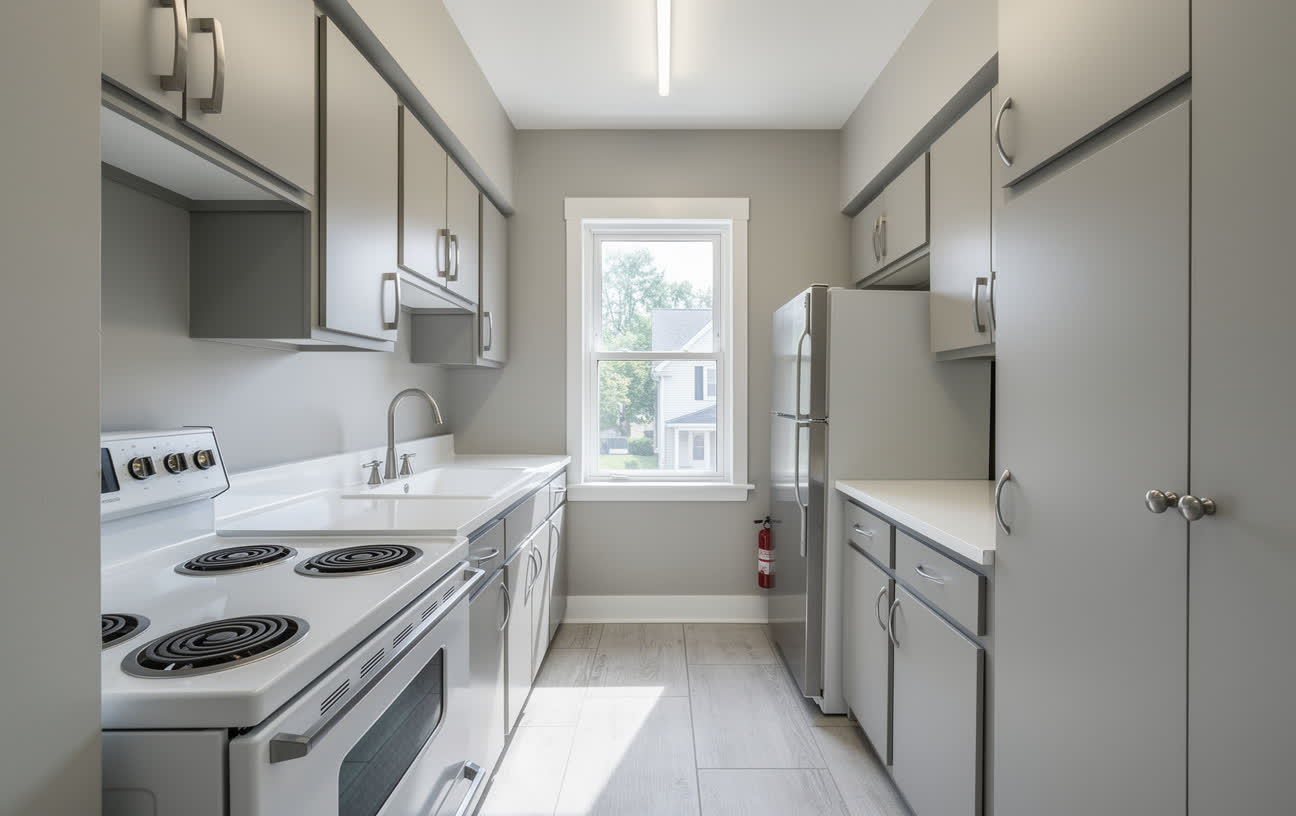
The constrained instruction. Same model, same photograph. The window, the range, the sink and the fridge stayed put.
With the loose instruction, the result is a lovely kitchen. It is also not the room in the photograph. The window has changed size and lost the radiator underneath it. The freestanding range with coil burners has become a stainless slide-in with a glass cooktop. The fridge has stepped out of its alcove. The doorway on the right has been cabineted over. And the sink is simply gone: there is no faucet anywhere in the picture. It is a kitchen you cannot order, because it is not the room you photographed.
With the constrained instruction, the window keeps its frame, its size and its view of the house opposite. The freestanding range is still a freestanding range with the same four coil burners, in the same place. The sink and faucet are still under the window. The fridge is still in the same alcove, the doorway on the right is still a doorway, and the camera has not moved. The model even left the fire extinguisher on the wall.
It is still not perfect. The constrained version removed the radiator under the window and swapped the white fridge for a stainless one. Instructions reduce drift. They do not abolish it, and anybody telling you their tool never drifts is overselling.
That is the entire difference between a general image tool and a tool built for rooms: not the model, the constraints wrapped around it. In ChatGPT, you are the only thing supplying those constraints, in a chat box, one message at a time.
How to get the most out of ChatGPT for a kitchen
If ChatGPT is what you have, use it for what it is good at.
- Use it for words, not pixels. Planning, budgets, sequencing, questions, decoding quotes.
- Ask it to interrogate you. "Ask me ten questions about how I cook before suggesting a layout" produces far better output than asking for a layout cold.
- Give it constraints it can actually use. Room dimensions, which way the window faces, what you are keeping, your budget. It reasons well over facts you supply.
- Do not trust it on prices or product availability. It does not know what your local supplier charges this month.
- If you do generate images, treat them as mood, not proof. They are useful for deciding you like dark green. They are not evidence that dark green works in your room.
Is ChatGPT kitchen design free?
Partly. OpenAI's pricing page lists image creation on the Free plan as "limited" and offers more of it on the paid plans.3 As of October 2026, you can try ChatGPT kitchen design without paying, but you can reach a usage limit.
OpenAI does not state a number on that page, so we will not guess one. The page also lists messages with uploads as limited on the Free plan, and a kitchen photo is an upload.
Text chats on the Free plan are listed as unlimited, with limits against misuse. That is the part this article recommends anyway: budgets, quotes, questions and sequencing. Whatever plan you use, treat a generated kitchen picture as mood, not proof.
When you need a different tool
You need something else at the point where the answer depends on your room rather than on kitchens in general.
That is the moment you are holding a color card against your own countertop, or trying to work out whether a tile that looks great in a showroom will look busy across your run. General knowledge cannot answer that. Only your room can.
For that job you want a tool that starts from your photograph and is built to hold the geometry still. That is what we do: you upload one photo, change one thing, and get your own kitchen back with the layout, window and camera angle unchanged.
We would still tell you to use ChatGPT for the budget conversation.
If you want to try this on your own kitchen, take the free 2-minute quiz. It asks what you are planning and takes one photo. You choose a plan to open your kitchen in the style it picks.
Sources
- Median major kitchen remodel, $55,000. 2026 U.S. Houzz Kitchen Trends Study, n=1,780 U.S. homeowners. Read the study
- Both quotations about masking and composition control are from OpenAI's image generation guide. Read the documentation
- ChatGPT Free plan: limited image creation, unlimited text chats. OpenAI, ChatGPT pricing page, checked 12 October 2026. Read the pricing page
The two comparison images were generated by us from the same source photograph, using the same model, changing only the instruction. They are a demonstration of how constraints affect output.
See it on your own kitchen before you commit
Upload one photo. Change the cabinets, the floor or the tile, and get your own room back with everything else exactly where it was.
Try it on my kitchen30 days money back. Cancel in one click. Failed generations never cost credits.